PS 26187 Video analytics for border surveillance on existing CCTV

Don't replace the cameras.
Make them intelligent.

Rakshak AI is a software layer for the CCTV already installed at border outposts and check posts. It analyses every feed, learns what ordinary movement looks like at each post, and brings forward only the events that need an officer's attention, each with its reasons and a record that holds up later.

Working today Detection, tracking, weapon alerts and incident logging on 13 camera feeds at once, on a 2016 laptop processor with no GPU. Context-aware alerting and sealed evidence are the next build stage. See exactly what is built →
rakshak · operations console · live
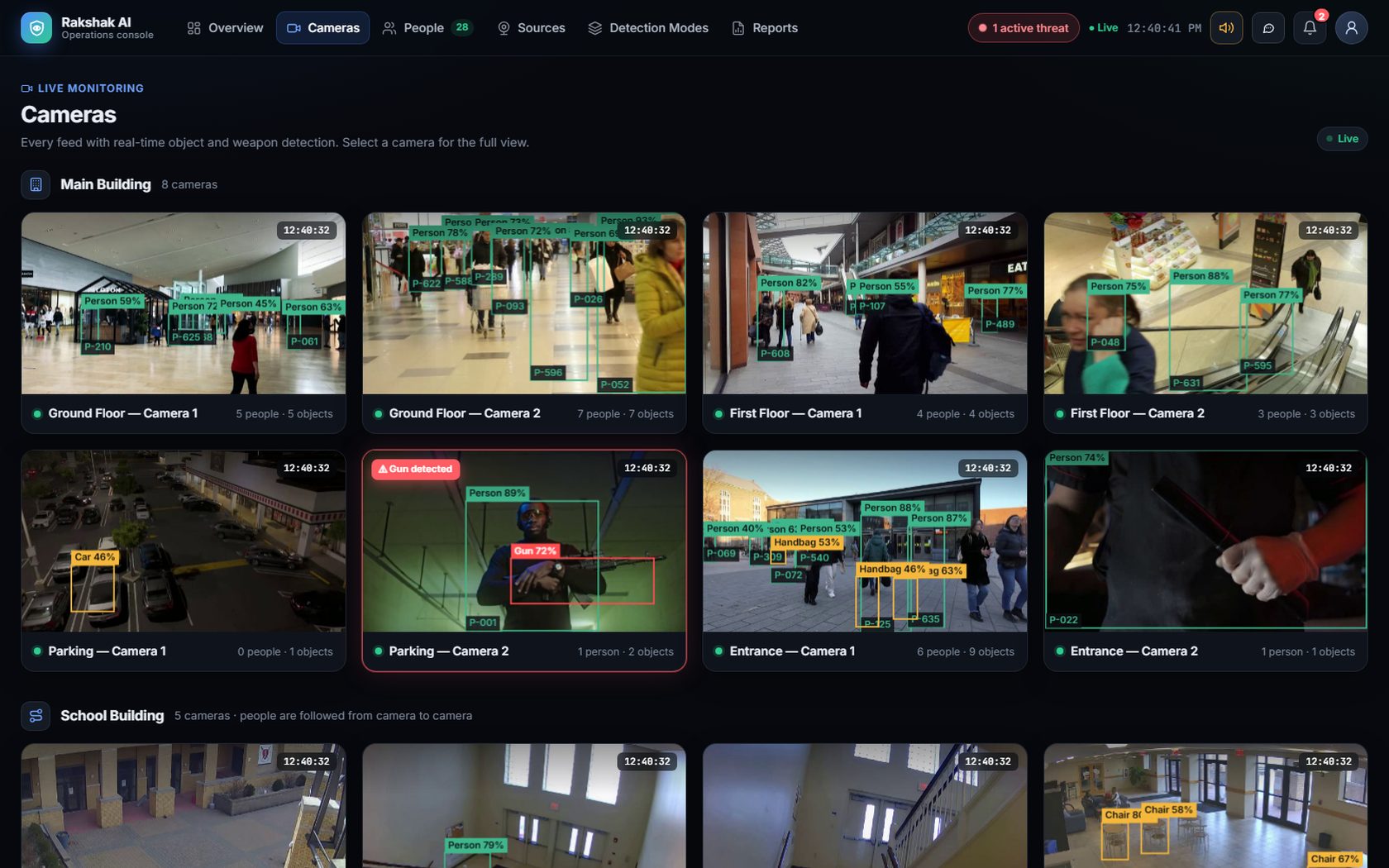
Rakshak AI operations console: a grid of live camera feeds with people, vehicles and weapons outlined by the detector
Knife · Entrance, Camera 2Confirmed on two passes · held by a person
13 feeds · 1 CPUFull pass every 2–3 s
2,450km

of open India–Nepal and India–Bhutan border guarded by the SSB1

734

SSB Border Out Posts on these two frontiers2

308

of those posts without road connectivity2. Hardware-heavy systems are hard to deliver and maintain there.

173

people rescued from traffickers by the SSB on the India–Nepal border in 20233

Sources are listed at the end of the page.

01 · The problem

On an open border, a crossing is not a signal. It is the background.

Under the 1950 Treaty of Peace and Friendship, Indian and Nepali citizens cross without passport or visa, to work, to trade at weekly haat markets and to visit family4. Movement never stops, and it swells on market days and at festivals.

The SSB's task is to find the unlawful fraction inside that movement: smuggling, trafficking, contraband. In 2023 alone it seized over 11 lakh kg of contraband in 2,068 cases3. Almost every interception began with a person noticing something.

Cameras that record but don't understand

Conventional CCTV gives recording and a live view, and someone has to keep watching. Research on operator vigilance shows attention to multi-screen video drops within minutes. A widely cited industry figure puts missed activity at up to 95% after 22 minutes5.

Intelligence that ships as hardware

Face recognition, number-plate reading and intrusion analytics usually arrive as dedicated appliances and proprietary smart cameras. They are expensive to buy and to maintain, and hard to take to 308 posts that have no road.

Alarms that nobody trusts

A rule that fires whenever someone crosses a line fires all day on this border. Operators learn to ignore it, and then it gets switched off. The detector isn't the weak point. Treating ordinary movement as the event is.

02 · The core insight

A more accurate model can't fix this on its own. The arithmetic shows why.

Suppose a busy post sees 10,000 crossings in a period and 10 of them are unlawful. A detector that is right 99% of the time on both kinds still raises about 110 alerts, and about 100 of them are false. Try the numbers yourself.

Every movement is a candidate, as with a virtual fence or tripwire.

91%of alerts reaching the operator are false alarms
110alerts raised
100false alarms
9.9genuine events caught
Genuine alertFalse alarmeach dot ≈ 1% of alerts

We don't make the classifier better. We make the denominator smaller.

The base rate works against even a good detector. The way out is to judge each movement against what is normal for this camera, at this hour, on this kind of day: its usual paths, its market days, its festival surges. Measured that way, 10,000 ordinary crossings shrink to a small set of genuinely unusual ones. Among those, a good detector becomes decisive. Radar engineers call the same idea CFAR, a constant false-alarm rate: the threshold follows local background levels, so the alert rate stays steady however busy the border gets.

The second scenario is illustrative arithmetic, not a measured result. It assumes unlawful movement is unusual in context. Someone who moves with the crowd, on the usual path at the usual hour, stays in the background, and we say so plainly below.

03 · The approach

Don't replace the infrastructure. Add a layer on top of it.

The cameras, cabling and control-room screens already exist. Rakshak AI adds one commodity computer at the post and software that turns those feeds into decisions and records. Nothing on the camera side changes.

Already at the post

  • IP CCTV at outposts, check posts and border roads
  • Recorders and control-room screens
  • A few personnel with many duties besides watching screens

The Rakshak AI layer

PerceptionDetect and track people, vehicles, animals and weapons in every frame
ContextZones, direction, dwell time, group movement, hour of the week
DecisionCompare each movement with the post's learned normal; keep the alert rate within budget
EvidenceOriginal frames sealed, logged tamper-evidently and ready for court

One commodity box per post. No GPU, no cloud, no new cameras.

What the unit gets

  • A short, ranked list of alerts, each with its reasons
  • Incident timelines and movement across cameras
  • Records that stand up as evidence
  • A shift report that is already drafted

CCTV

Existing IP cameras, USB cameras, phones and recorded footage.

Partly built

Video data

Frames decoded, normalised and buffered, so every frame shown is the one analysed.

Working

AI analysis

Object and weapon detection on a CPU, with no special hardware.

Working

Detection

Tracks, cross-camera journeys and behavioural context, judged against the post's normal.

Partly built

Alerts

One incident per event, with severity, reasons, sound and operator actions.

Working

Actionable intelligence

Reports, history and export, plus sealed evidence and drafted paperwork.

Partly built
04 · How it decides

Four design principles. One idea, applied end to end.

Detection models are widely available and interchangeable. What makes a system usable at a real post is how it decides, what it hands over and how much work it saves. Each principle below is marked with where it stands today.

In development
PRINCIPLE 01

Model the normal, not the threat

Each post learns its own pattern of lawful movement, and an alert fires only when the evidence against that pattern is strong enough.

  • The baseline is kept per camera, zone, hour of the week and calendar: market days, Dashain, Chhath. It stores counts, never images or identities.
  • Evidence builds up over distinct observations: zone entry, dwell, direction, group movement and rate for the hour. It does not accumulate frame by frame, so one long clip doesn't count many times.
  • The threshold is set from the post's own history so that false alarms stay near a chosen rate (conformal thresholding). A target budget of 12 alerts per operator per 8-hour shift covers market days too. Nothing is discarded: lower-ranked events go into the shift digest.
  • When there is too little history, the system says insufficient data and falls back to conservative fixed rules instead of inventing a baseline. It also detects when the world has changed (a new road, a moved market) and recommends recalibration instead of alerting for weeks.
TodayThe prototype runs the conservative fixed-rule layer: weapon type × confidence, confirmed across two passes.
In development
PRINCIPLE 02

Every alert is evidence

The output of the system is a record that can be produced in court, not only a notification.

  • The original frame is kept for the record. Low-light enhancement runs only on the copy used for detection, so enhanced pixels never enter the evidence.
  • Clips are captured from before and after the event and sealed with a SHA-256 hash.
  • Events go into an append-only log where each entry carries the hash of the one before it. Any edit or deletion shows up at the exact entry where it happened.
  • A draft certificate under Section 63(4) of the Bharatiya Sakshya Adhiniyam, 2023, including the hash value, is prepared at capture6. The investigating officer reviews and signs it.
TodayEvery incident keeps its snapshot, times, sightings and a full, timestamped history of operator actions.
Partly built
PRINCIPLE 03

From alerts to cases

Surveillance becomes useful to an investigation when events connect across cameras, hours and days.

  • Repeated sightings fold into one incident with a timeline, not a stream of duplicate alarms.
  • Journeys are rebuilt across cameras, and a link is made only where a person could actually walk between them in the time available.
  • Recurring patterns are surfaced for the intelligence wing, for example the same place and the same hours several times in two weeks, always off the usual path.
  • Records are searched by a deterministic parser. No language model sits in the evidence path, so a search cannot invent an incident.
TodayIncidents are deduplicated with timelines, and journeys across five cameras can be tried in the prototype.
Designed
PRINCIPLE 04

Built for the unit, not for a demo

A system gets switched off when it adds work. This one is designed to take work away and to be directed like any other collection asset.

  • Watch Orders: an officer acting on information picks cameras and a time window and raises sensitivity for that window only. The order is audited, expires automatically and ends with a report, including an honest "nothing observed".
  • Shift report: at handover the system drafts the situation report, covering coverage, gaps, alerts, actions and sealed evidence. The sentry corrects and signs it.
  • Unattended posts: an alert is a 30-second decision on a duty phone, with a local alarm. The digest covers the hours when nobody was watching.
  • Language: screens and reports in Hindi and the regional language of the post. Court documents stay in English.
TodayAlerts already play a sound, and operators can mark them "Working on it" or "Resolved" and add notes.
Why this alert firedCAM-03 · 02:14 Tue · track #41 · person
+4.1RATE_ANOMALY2 crossings vs a learned rate of 0.3 for this camera, 02:00 Tuesdays (n = 21 nights)
+2.3OFF_PATH180 m from the nearest designated crossing point
+1.8ZONE_ENTRYEntered restricted zone "Ridge North"
+1.2GROUPMoving together with track #42: proximity, heading, speed
+0.9DWELL47 s stationary at the treeline
Evidence = 10.3p = 0.008 against 1,240 past episodes at this camera and hourα = 0.02 → ALERT
Illustrative example of the planned alert format. The figures are not measurements. Every term is a named statistic that adds up, so an officer can explain the alert in a witness box.
02:14RAKSHAK
CAM-03 · Ridge North
2 people, night, off the usual path
At this confidence, 4 in 5 alerts were genuine
SeenSend teamNot a threat

Illustration. Designed for posts with nobody at a screen: one image, one reason, one honest confidence and three buttons. "Not a threat" teaches the system.

How this differs from conventional intrusion analytics

Conventional intrusion analyticsRakshak AI
What triggers an alertSomeone crosses a line or enters a zoneEvidence builds up against this post's learned normal until it is enough
ThresholdTuned by hand, the same everywhereSet per camera and hour from local history
Alert volumeFound out in the field, usually too lateA design parameter held within a stated budget, busy days included
Confidence shownA score such as "87/100"A calibrated frequency: "4 in 5 at this level were genuine"
When the world changesA new road means weeks of false alarmsThe shift is detected as drift and recalibration is recommended
When data is thinGuesses silentlyReports "insufficient data" and uses conservative rules
What is handed overAn exported video clipA sealed clip, a hash-chained log and a drafted Section 63 certificate
05 · What runs today

A working system you can open, not a mock-up.

The prototype is live software. Every screen below is a real capture, and every capability in this section can be tried in it. It is the perception and alerting base that the decision and evidence layers are being built on.

13camera feeds analysed together in one shared pipeline
2–3 sfor a full detection pass over all 13 feeds (measured on this laptop)
No GPUeverything runs on a 2016 dual-core laptop CPU (Intel i7-6600U)
5visibility conditions tested: day, night, thermal, fog, rain and snow

People, vehicles and objects

A YOLOv8n model running on ONNX Runtime detects people, cars, buses, trucks, motorcycles, animals and dozens of other everyday objects (80 classes) on every feed, all on a CPU.

Weapons, with false-alarm filtering

A dedicated model detects guns, knives, grenades and explosions. A weapon counts only if it is seen on two passes and a hand-held one sits inside a detected person, which rules out one-frame errors.

Journeys across cameras

Every person gets an ID. Across five synchronised cameras, appearance matching links a person only between cameras they could walk between, and a timing check rules out being in two places at once.

Incidents, not alarm floods

One incident per camera and threat type, with severity, a sound alert, "Working on it" and "Resolved" actions, notes and a complete history. Incidents survive restarts and export to CSV.

Any camera, one pipeline

Recorded CCTV, laptop and USB webcams, and phone cameras over the local network (scan a QR code) or a USB cable. You can switch sources without restarting, and every source goes through the same detection and alerts.

Honest display and camera health

Video is shown a few seconds behind live so boxes are drawn on the exact frames that were analysed. Each camera reports Online, Signal problem or Offline, and a stalled detector is flagged.

What the prototype is not yet. It reads recorded footage, webcams and phones. Direct RTSP/ONVIF ingestion from IP cameras is the first item in the next build stage. Its alerts come from fixed rules, not yet from a learned baseline. Footage is from public datasets and stock sources, not from a border post. Throughput figures are from a laptop that is also serving the dashboard.

06 · Requirement by requirement

Where each requirement stands

Every capability the problem statement asks for, and its status in Rakshak AI today. Nothing here is rounded up.

Working in prototypePartly builtIn developmentDesigned
RequirementStatusDetail
Human detection and trackingWorkingDetection on every feed; per-camera IDs; journeys across five synchronised cameras.
Vehicle detection and classificationPartly builtCars, buses, trucks, motorcycles and bicycles are detected and labelled. Per-vehicle analytics such as counts, direction and dwell are next.
Night-time movement detectionPartly builtThe unchanged pipeline is shown on night, thermal, fog and rain footage. Low-light enhancement (on an analysis copy only) and per-condition measurement are next.
Real-time alerts and event loggingWorkingIncidents with severity, sound, operator actions, a history log, snapshots, reports and CSV export.
Suspicious activity detectionPartly builtWeapon detection works. Dwell, direction, group movement and the per-post baseline are in development.
Ingest from standard IP camerasIn developmentThe pipeline already takes any frame source (files, webcams, phones). RTSP/ONVIF with auto-reconnect and gap logging is the next item.
Virtual fence intrusion detectionIn developmentZones and directional tripwires drawn on the live view, used as one input to the decision rather than a direct alarm, because on an open border crossing is normal.
Face detectionDesignedDetection on by default. Recognition is a separate module, off by default, and enabled only by an audited administrative action.
Automatic number plate recognitionDesignedPlate location and OCR for Indian formats, with accuracy on clean and degraded footage reported separately.
Integration with command and controlPartly builtThe console already runs on REST and WebSocket APIs. A documented integration API for outside systems is designed.
No dedicated surveillance hardwareWorkingEverything above runs on an ordinary laptop CPU with no GPU and no special cameras.
07 · Deployment

Built for posts with no road, no network and no engineer.

The design assumes the hardest post, not the easiest: intermittent power, no reliable link and nobody trained in IT. Everything else is easier.

BOP

Existing cameras + one box

BOP

Runs fully offline

BOP

Syncs when the link returns

Sector / Frontier HQ

Cross-post view, journeys and recurring patterns, Watch Order management, access control and audit. Alerts go on to existing command-and-control systems through a documented API.

Commodity compute, no GPU

A mini-PC class machine per post. The prototype already runs 13 feeds on a 2016 laptop CPU. A real post needs 4–6 cameras per box.

Offline by default

All analysis happens at the post with a local store. Data is kept and forwarded when a link exists. It can run air-gapped with no cloud dependency.

Works with what is installed

IP cameras over RTSP/ONVIF, plus USB cameras, phones and recorded files. No camera replacement and no proprietary appliance.

Set up and maintained by the post

A single-package install. Zones are drawn over the live view. Cameras report their own problems, such as a blocked lens, lost focus or signal loss.

Estimated cost ≈ ₹2.4 cr

to equip all 734 SSB Border Out Posts once with a Rakshak Edge Box (about ₹32,500 per post), on cameras the force already owns. No per-camera licence and no recurring cloud bill.

Intel N100 mini-PC board (4-core, fanless)₹13,000
16 GB RAM + 512 GB NVMe SSD₹8,000
4-port PoE+ switch for the cameras₹3,500
12 V mini-UPS, IP65 enclosure, 4G modem, cables₹8,000
Cameras · software licence · cloud₹0
Edge Box per post, one time≈ ₹32,500

An indicative estimate at 2026 retail prices, excluding GST and installation; not a quotation. The box is a reference build from off-the-shelf parts that can be bought through standard government procurement.

08 · Responsible by design

The system detects and explains. A person decides.

Most people in frame on this border are crossing lawfully. The design treats that as a constraint on the architecture, not a policy footnote.

No autonomous decisions

Rakshak AI detects, explains and records. An officer decides. Every action is attributable. Enabling recognition or changing retention needs a second person.

Lawful movement leaves no identity record

The baseline stores counts per time slot, never faces, images or names. Detection is on by default. Recognition is an exception: off unless enabled, audited and kept on a shorter retention schedule.

No new surveillance powers

It reads footage the force already collects lawfully on its own cameras. Records use neutral language, for example "restricted area entry", never "confirmed infiltrator".

What it will not catch, stated plainly

Someone who moves with the crowd, at market hour, on the usual path and carrying an ordinary bag, looks like the background. By design they will not be flagged. That is why Rakshak AI is one stream among several, alongside patrols and human sources. It is also why an officer with a tip-off can direct it with a Watch Order. The system shows its own blind spots through the shift digest, camera-health reports and the "insufficient data" state, so nobody mistakes it for an oracle.

Validation

The acceptance test we propose, including when to reject us.

A 30-day pilot at one Border Out Post, on existing cameras, scored by the unit, not by us. The criteria are fixed before the test runs.

#CriterionPass conditionIf it fails
OAT-1Alert volume≤ 12 alerts per operator per 8-hour shift, sustained through a market day or festival surgeReject
OAT-2Alert precision≥ 50% of alerts judged operationally meaningful by the duty commanderReject
OAT-3CalibrationStated confidence matches observed outcomes (expected calibration error ≤ 0.1)Recalibrate, retest
OAT-4Missed eventsEvery event the unit independently knew of appears in the digest, even if it didn't interrupt the operatorReject
OAT-5Evidence integrityEvery seal and the full log chain verify at month endReject
OAT-6Availability≥ 95% of camera-hours processed, with every gap loggedInvestigate
OAT-7AdoptionStill switched on, unprompted, on day 30Reject

The headline claim needs no labelled data

A false-alarm rate is a property of ordinary traffic, so it can be checked on unlabelled footage from the post itself. No labelled dataset of border smuggling exists, so an approach whose central claim depends on one can't be verified.

Detection rate is measured separately

How often real events are caught is measured on staged, logged events and reported as that, never mixed into field figures. Every number we publish comes with its sample size.

09 · Roadmap

What exists, what is next, and how it gets proven.

Now · Sep 2026

Working prototype

  • Detection of people, vehicles and objects
  • Weapon alerts with false-alarm filtering
  • Tracking and cross-camera journeys
  • Incidents, actions, reports, export
  • Webcam and phone sources, condition tests
Next · Oct–Nov 2026

Decision and evidence core

  • RTSP/ONVIF camera ingestion
  • Zones, dwell, direction, group movement
  • Per-post baseline, adaptive threshold, alert budget, shift digest
  • Sealed clips, hash-chained log, Section 63 draft
  • Watch Orders and the drafted shift report
  • Measurements on our own fixed-camera footage
Pilot · 0–6 months

One frontier, real posts

  • 2–3 Border Out Posts on existing cameras
  • 30 days against the acceptance test, scored by the unit
  • Face detection and number-plate reading added
  • Hindi and regional-language interface
6–18 months

Scale and integrate

  • Thermal and ground sensors under the same statistical framework
  • New posts starting from priors pooled across similar posts (statistics only, no video)
  • Integration with command-and-control systems
  • A hardened edge appliance
10 · See it working

Open the prototype and try it yourself.

It runs live: 13 camera feeds, weapon alerts, journeys across cameras, and detection in night, thermal and fog footage. You can also connect your own phone camera.

  1. OverviewThe threat score, active incidents, camera health and recent alerts on one screen.
  2. CamerasOpen the Parking or Entrance feeds to see weapon detection and its confirmation.
  3. PeoplePick a person from the School Building and follow them across five cameras.
  4. Detection ModesRun the same pipeline on night, thermal, fog and rain footage.
  5. SourcesScan the QR code to stream your phone's camera into the same pipeline.
11 · Your feedback

Tell us what holds up, and what doesn't.

We are building this for people who run, study and secure real surveillance systems. A candid view from you is worth more to us than praise.

  • Takes about two minutes. Only your role and rating are required.
  • Stored on the team's machine only. It isn't shared or published.
  • Leave contact details only if you want us to follow up.
How useful could this be in real operations?

Sources

  1. Ministry of Home Affairs, Department of Border Management: India–Nepal border 1,751 km; India–Bhutan border 699 km, both guarded by the Sashastra Seema Bal.
  2. The Tribune, "308 SSB outposts on Nepal, Tibet borders await road connectivity": 734 outposts on the two borders, 426 with road connectivity. tribuneindia.com
  3. SSB figures for 2023 on the India–Nepal border as reported by IANS: 144.5 kg of narcotics (66 cases), 11,11,054 kg of contraband (2,241 arrests, 2,068 cases), 83 men and 90 women rescued from traffickers. prokerala.com
  4. Treaty of Peace and Friendship between India and Nepal, 1950.
  5. Up to 45% of activity missed after 12 minutes and 95% after 22 minutes: an industry figure widely attributed to Ainsworth (2002). It is often repeated and not rigorously established. On operator vigilance and workload, see Dadashi et al., "Semi-automated CCTV surveillance", Applied Ergonomics (2013). sciencedirect.com
  6. Bharatiya Sakshya Adhiniyam, 2023, Section 63: admissibility of electronic records; the Section 63(4) certificate includes the hash value of the record. indiankanoon.org. Its validity was upheld by the Supreme Court in July 2026. scconline.com
  7. Methods: CFAR detection (cell-averaging and order-statistic); inductive and Mondrian conformal prediction (Vovk et al.); CUSUM and Page–Hinkley change detection; isotonic calibration and expected calibration error; YOLOv8 (Ultralytics); OSNet person re-identification; MEVA multi-camera dataset (school-building feeds).

How we use numbers. Every figure about Rakshak AI on this page is one of three things: measured on the prototype, labelled as a design target, or labelled as an estimate. External figures carry a source. The worked alert example is illustrative and says so.